The train ride from Juarez to Chihuahua City is only four hours long but it’s a tough four hours. The heat, the dust, and the noise from my rowdy traveling companions make the work I had planned almost impossible. I’ve got a lot more reading to do to prepare for my interview with the feared and gringo-hating revolutionary, Pablo López. López was Pancho Villa’s second in command and his most trusted general before his wounds put an end to his marauding and put him one day away from a firing squad.
This trip may well be a waste of time given López’s hatred for all things American. Until now he has not granted an interview to an American journalist but this being his last day on earth my boss at the Associated Press thought I could get in to see him. Me, a pale faced gringo with my textbook Spanish. Wish me luck.
I don’t know much about López other than he’s been riding with Villa since the very beginning. Both he and his brother Martin rose from the ranks of common foot soldiers to become Villa’s most famous and brutally cruel generals. López was wounded in the siege of Columbus, New Mexico and was left to die in a cave before he turned himself in to the federales. They sentenced him to death as soon as he could physically stand and face a firing squad. His execution is scheduled for tomorrow at noon.
Our train pulls into Chihuahua City station with a lot of dust, steam and even more noise. I head directly out to Santa Rosa penitentiary. The taxi driver is curious why a gringo would want to go to such an evil place. I tell him that I am to meet General Pablo López and he is visibly shaken. “Pablito is one of our greatest heroes,” he says solemnly. “Please give him my and the people of Chihuahua’s best wishes. Tell Pablito, our prayers are with him.”
The driver’s reverence for the villain that the U.S. press has dubbed The Butcher is troublesome and goes against everything I’ve learned about López. I can’t wait to see if this respect is earned or merely the fodder for local folklore.
The prison is grimy in that sort of way that only old adobe can look. The place is swarming with federalist soldiers in their bright dress uniforms. They look better suited for a parade than guarding this crumbling old prison. The warden is very skeptical that López will actually see me given that I am an Americano and a pale one at that. We talk for a while longer as I try to convince him that I am more than the typical gringo. I am here to tell López’s story to the world on this his last day on earth. The warden gives in and I’m escorted down this long dark hallway past empty, smelly cells on my left and a dingy wall on my right.
The guard opens a rusty steel door and ushers me into a ten by ten foot cell furnished with a cot, a bucket for a toilet and a single old chair with three and a half legs. López is stretched out on the cot in an undershirt and simple street clothes with his legs raised up on two pillows. He growls at me, “What are you doing here, gringo?”
“I’m from the Associated Press and I’ve come all this way to see if there’s anything you’d like to tell the world before … ah … the … ah … tomorrow. I stammer in my schoolboy Spanish.
“I don’t talk to gringos especially pasty white gringos like you.”
“I won’t apologize for my pale skin; its just part of being Irish.”
“Ah, why didn’t you say you were Irish? I am a big fan of the Irish and their long struggle for freedom – their rebellion against English repression.” López says. “If you are Irish you are not then a gringo. Sit down my Irish friend and we will have that talk.”
“Thank you, General. My taxi driver asked me to tell you that the people of Chihuahua wish you the best and are praying for you.”
“That is very kind of them. I wish I’d had more time to spend with the peasants of my country. They so need the help of Don Pancho and everything we tried to accomplish.
“Tell me about the beginning and the causes that have driven you.”
“I am just a poor, ignorant peon whose only education is in leading oxen and following a plow. When the good Francisco Madero led peasants against their masters my brothers and I eagerly joined him. Villa is the hero of all of us who have grown up in oppression. I was one of the first to sign on with him and I have been his faithful servant to this day.” López says proudly.
“That was in the beginning but what about now?”
“Don Pancho is convinced that the U.S. wants to take over Mexico by putting one Mexican against another until we kill each other off so that our depleted country will (como una pera madura) fall like a ripe pear into the U.S’s greedy hands. Don Pancho also told us that Carranza was selling our northern states to the gringos to get money to keep himself in power. Don Pancho wanted to get the intervention of the gringos before they were ready and while we still had time to become a united nation.”
“Your raid into New Mexico succeeded in getting the U.S. involved. I was told that the U.S. troops almost captured you down in Santa Ysabel.”
“No! No! Would I have surrendered to the gringos? No, señor, many times no! I have often been in tight places when wounded, but have never thought of surrendering. If the gringos had found me I would have fought to the last and kept one cartridge for myself. I gave myself up to the federales so that I could die like a man, like Don Pancho would have wanted me to.”
“Can you tell me about the Santa Ysabel train incident back in January,” I asked hoping to calm the now animated López.
“Me and thirty or so of my men attacked a train traveling from Chichuhua City to the mining town of Cushuiriachic. We had heard there were rich Americans on board and we needed their clothing and their money.”
I remember reading that Charles Watson, the manager of the Cusi Mining Co., and 16 other U.S. citizens were forced from the train, stripped and shot execution-style by López and his men. López entered the train and harrassed the passengers, both Mexican and American alike. He hollered to the Mexican passengers, “If you want to see some fun, watch us kill these gringos.” López fanatically incited his men with repeated cries of, “Viva Villa!” and “Muerte a los gringos!”
López didn’t want to talk about the brutality that had earned him the name, The Butcher. Instead, he unexpectedly apologized.
“Things might not have gone as they did but somehow we got bit by the devil,” López said with a smirk. “We would have been content with their clothes and their money but those gringos started to run and our soliders began to shoot. (El olor de la polvora nos enciende la sangre) The smell of powder makes our blood hotter. Things got out of hand and it was all over before I realized what was really going on. I’m sorry now that I didn’t stop my men from killing all of those gringos.”
I was eager to hear the General’s views of their raid into the U.S. Villa had launched an attack on Columbus, New Mexico early in the morning of March 9th. López and his troops entered the town shouting Viva Villa and began burning the village while the Americans slept. Villa’s men looted and burned houses shooting every gringo they encountered. Interestingly, they did not harm any of Columbus’ many Mexican-American citizens. The Villistas were 500 or so strong and yet only eighteen Americans were killed along with another eight wounded. The raid was a disaster for Pancho Villa. He lost almost 200 of his 500 man force and obtained very little in either revenge or much needed supplies.
General López was severely wounded during his raid of Columbus. He was shot in the chest at exactly the point where his bandoliers crisscrossed knocking him off of his horse. As he was sitting on the ground another shot went cleanly through both of his legs. Tough guy that he is, he crawled to a stray horse, somehow mounted it and joined Villa’s retreating army. He rode with his wounds untended for seventeen miles and then collapsed at their first rest stop. His men placed the seriously ill López on a stretcher and carried him on their shoulders all the way to Ascensión where Villa commandeered a buggy. Later when it was determined that López could go no farther they left him behind, hidden in a cave near Santa Ysabel.
“We were disappointed over the Columbus raid. All we got were some horses, many bullets and a lot of hell. But none of that matters now. I would have prefered to die for my country in battle but I will die as Pancho Villa would wish me to … with my head held high and my eyes unbandaged … and history will not be able to record that Pablo López flinched on the brink of eternity.”
“All we wanted is revenge against the Americans,” López yelled. “The gringos are responsible for our defeats at Agua Prieta and Celaya by allowing Carrancistas to travel across the U.S. to reinforce their garrisons and by selling us defective weapons and ammunition. And, did you know that 20 Mexicans were arrested in El Paso and as they were being soaked in kerosene for delousing, some gringo set fire to these men. They were all burned alive. What do you make of that, Irish?”
It was clear this proud man was not going to say any more about his and Villa’s greatest failure, the battle of Columbus. He just shut his eyes and feigned sleep. I thanked him, rose and departed without a handshake or an adiós. I had been dismissed.
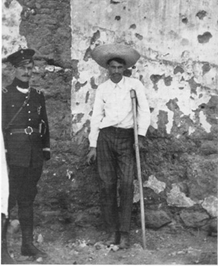
Pablo López • Execution June 5, 1916
On June 5th, the following morning, I joined an assembled crowd in the courtyard of the prison. All eyes were on the blood stained, pitted wall; the wall that has seen many of López’s fellow revolutionaries. López came out into the courtyard from our rear in a crowd of guards. He smoked a cigar as a friend helped him along on his home-made crutch. He wore a brilliant white shirt so that his executioners could easily find their target. López spoke to the assembled crowd as he was led across the courtyard, “Yes sir, Pancho Villa is a man, a real man. I know he has not died. He is peacefully resting in the mountains waiting for the time to come back and act … and all of Mexico will be on his side.”
I felt privileged when López demanded the removal of another American reporter from his execution ceremony by shouting, “I do not want to die in front of that dog.” He was going to take his hatred of gringos to his grave.
He took off his straw sombreo, tossed down his crutch and gestured to the firing squad, “(En el pecho, hermanos, en el pecho) In the breast, brothers, in the breast.”
 Too Much Tequila, Too Little Sunscreen