I started at Astrodata three years earlier as a second-shift electronic tech while I was a full-time college student. I had been promoted four times and was now a junior doobie in the sales department assisting with proposal writing and other customer related activities. They gave me a big office over in executive row and I rubbed elbows with the powers-that-be including my new friend and mentor Charlie Marsh, our VP of Sales.
I was soon a full-fledged member of Charlie’s inner social circle. Charlie would have Peter, Gordon, Jim, and me over to his house for cocktails after work a couple of times a week. Charlie was an impressive guy. He came from wealth and grew up outside of New York City on the Jersey shore. He collected old Colt revolvers and was an expert on the various types and models. Once on a visit to the Tower of London he saw a Colt on display, mislabeled. He reported it, they corrected it, and Charlie was awarded a certificate as an honorary curator. A curator of the Tower of London!
In addition to all of his antique pistols Charlie rebuilt a civil war cannon. He bought an authentic barrel and all the hardware pieces and built the wooden carriage and wheels from plans he got from the Smithsonian. It was a meticulously restored 1862 3-inch Ordnance Rifle used by both sides in civil war.
Often after too many cocktails we would wheel the cannon out of Charlie’s garage and shoot a tennis ball over the city of Tustin, California. We would pack a pound or two of black powder wrapped in aluminum foil into the breech with a ramrod, pound a wad of newspaper behind it before inserting a tennis ball. And with a knitting needle we would poke a hole in the foil down through the touch hole and fill it with black powder. When you lit the powder with a match the cannon roared with a deafening boom, bounced a foot or so off the ground, and filled the driveway with smoke. With our ears still ringing we’d wheel the cannon back into the garage and slam the door before the neighbors had a clue.
I was just taking off my jacket one morning when Judy, our department secretary, peeked around my office door and said like she knew something was up, “Charlie wants to see you in his office right away.” I thought, oh shit, what have I done now, as I hurried to Charlie’s big office at the end of the hall.
Charlie gave me a host the instructions on how to supervise the transporting of his cannon from his garage in Tustin to Anaheim Stadium. The Anaheim Stadium where the Angeles play. I got the cannon to the field and with help carefully wheeled it down the third base warning track. The groundskeeper seemed overly concerned about his precious grass as we rumbled the clunky cannon along down the track. We dropped it at the third base dugout and I said goodbye to the grounds crew and headed back to the office.
A few days later I donned a Confederate enlisted man’s uniform and joined Peter and Jim equally attired along with Charlie decked out in a flamboyant Colonel’s uniform. We ducked as he excitedly waved his sword. We were going to be the opening act in the Fourth of July spectacular fireworks show. The stands were filled with thousands of people including Linda and our girls.
 Charlie’s 1862 3-in. Ordnance Rifle
We were to wait in the third base dugout until we heard the announcer say something about the first shot fired at Fort Sumter. We would then walk out on to the field in a military formation and simulate loading the preloaded cannon with a lot of ramrod ramming. When Charlie dropped his raised sword Peter touched off the cannon. We had put way too much powder in the cannon and the boom rocked the stadium. Linda was sitting high up in stands over toward first base and she felt the blast of hot air. I had just played Anaheim Stadium.
Charlie had been in the analog computer business since the beginning in the early 50s and knew everyone in this specialized industry: the luminaries, all of members of the Simulation Council, most of the users, and all of our competitor’s management. We were showing of our new systems at a computer show in Atlantic City. Our island booth was accommodating except it faced directly into the rear of our biggest competitor’s exhibit.
Not happy with this, Charlie went out to a novelty shop on the boardwalk and came back with something in a large bag. Later when the coast was clear Charlie snuck up to our competitor’s computer and attached his surprise. We all chuckled when we recognized what Charlie had hung on their system, a life-size, plastic urinal. I watched the traffic closely to see what the conference attendees thought of Charlie’s little prank. No one noticed the urinal even though many looked directly at it. Did this experiment prove that the brain blocks out things that are totally out of context?
Zubin Mehta, the Music Director of the Los Angeles Philharmonic Orchestra took Charlie and his cannon out to an old abandoned winery east of LA and recorded a number of cannon shots which he included in his Tchaikovsky 1812 Overture album. Charlie is listed on the album jacket as The First Cannon.
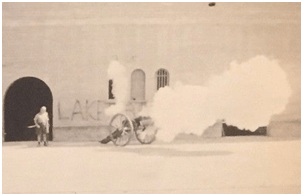
Charlie firing his cannon at an abandoned winery for Zubin Mehta
Zubin invited us to fire a live shot at the Hollywood Bowl when he performed Tchaikovsky’s 1812 Overture. We hung out backstage at the bowl like a couple of groupies after loading the cannon and inserting an electronic ignition device. Charlie introduced me to Zubin and then led us to a VIP box right down front in the big bucks section. We learned that one of the things you do at the Hollywood Bowl is try to outdo your neighbors with the most ostentatious picnic. Their gold candelabras, fine crystal, and gourmet food put our pizza box to shame. The concert highlight was Charlie’s cannon and a boom that must still be echoing around LA. The other 15 shots by movie-prop cannons sounded like pop guns compared to Charlie’s.
Charlie and I had now played Anaheim Stadium and the Hollywood Bowl.
The next thing we knew Charlie was on network TV. He was a contestant on the popular game show What’s My Line?, a show where celebrity panelists question the contestant in order to determine his or her occupation. We all got together at Charlie’s house to watch him stump the panelists with his latest calling, First Cannon for the Los Angeles Philharmonic Orchestra.
Astrodata folded shortly after Charlie’s TV premier. We were all out of work. Two weeks later I got a call from Charlie. He was the new Vice President of Sales and Marketing for Non-Linear Systems (NLS) down the coast in Del Mar and he wanted me to join him.
NLS was a family owned electronic business just off I-5 at the border of Solana Beach and Del Mar. The founder and owner’s claim to fame was that he invented the digital voltmeter. NLS had a small instrument business and looked to me to define and market some computer system products. Charlie and I soon sketched out a small data acquisition system that would log, record, and analyze data taken from any number of NLS digital devices. I sold a number of these systems before being recruited to Digital Equipment Corporation.
I said goodbye to my boss, my mentor, and my dear friend and moved to Los Angeles. We stayed in touch over the next few years and I stopped in to see him whenever I was near San Diego.
Charlie died of brain cancer a few years later.
I’ll always remember my tutor, mentor, coach, and role model, Charlie Marsh. He took a young electronic technician and groomed him into a polished and successful computer sales and marketing executive.
If you ever hear an unexplained window-rattling boom or if a tennis ball ever bounces off your roof, don’t fret, it’s just Charlie firing his cannon.
I really miss him.


 Too Much Tequila, Too Little Sunscreen